10 Best Open Source CRM Platforms for Small Businesses
Quick Summary: The best open source CRM is the one your team can maintain without hidden fees or technical headaches. AgentSDR leads for outbound teams with built-in email, LinkedIn and WhatsApp, while Twenty fits modern general use, Frappe CRM minimizes per-user costs, and EspoCRM combines sales with customer support. Before choosing, compare hosting, backups, upgrades and administration time, then test real contacts and one pipeline.
A two-person agency can adopt a free CRM, then quietly burn 300 hours of founder time a year keeping it running. The best open source CRM is rarely the one with the longest feature list; it is the one that stays alive. Paid small business CRM tools scale badly with per-seat pricing, while many "open source" options are really open core, with outreach features locked behind paid extensions. This shortlist ranks ten platforms for a small business CRM, weighing setup time, true hosting costs, and multichannel outreach. We scored each on time to a working pipeline, monthly cost at 5 to 20 seats, core CRM coverage, outbound capability, self-hosting maturity, and managed hosting availability, so you can pick the best free CRM for how your team actually works.
Open Source CRM Comparison
| CRM Platform | Best for | Setup difficulty | Pricing model | Multichannel outreach |
|---|---|---|---|---|
| AgentSDR | Outbound-first B2B teams wanting email, LinkedIn and WhatsApp in one workspace | Low to moderate, Docker-based self-hosting with documentation | Open source self-hosted, no per-user licence fee | Email, LinkedIn and WhatsApp built in |
| Twenty | Small teams migrating from HubSpot or Pipedrive who want a modern interface | Moderate self-hosting, or zero effort on managed cloud | Open source core, paid cloud hosting and enterprise extras | Email sync and calendar, sequence tooling lighter than specialists |
| Frappe CRM | Small teams wanting unlimited seats at the lowest running cost | Low to moderate, Frappe Cloud available for teams avoiding servers | Open source, free self-hosted with optional paid hosting | Email and WhatsApp supported natively |
| EspoCRM | Small businesses combining sales and customer support in one tool | Low, quick install on standard VPS hardware | Open source core, paid extensions and official cloud hosting | Email, web and telephony extensions available |
What to know about open source CRM platforms
An open source CRM runs on your own or low-cost hosting and usually charges no per-user licence fee. That makes the software cost close to zero, which is why it attracts nearly every small business CRM buyer.
The trade-off: you own hosting, backups and upgrades. Many "open source" tools are actually open core, with key sales features locked behind paid plans.
So the real question is simple. Which platform can a non-technical owner keep running without hiring an engineer?
1. AgentSDR
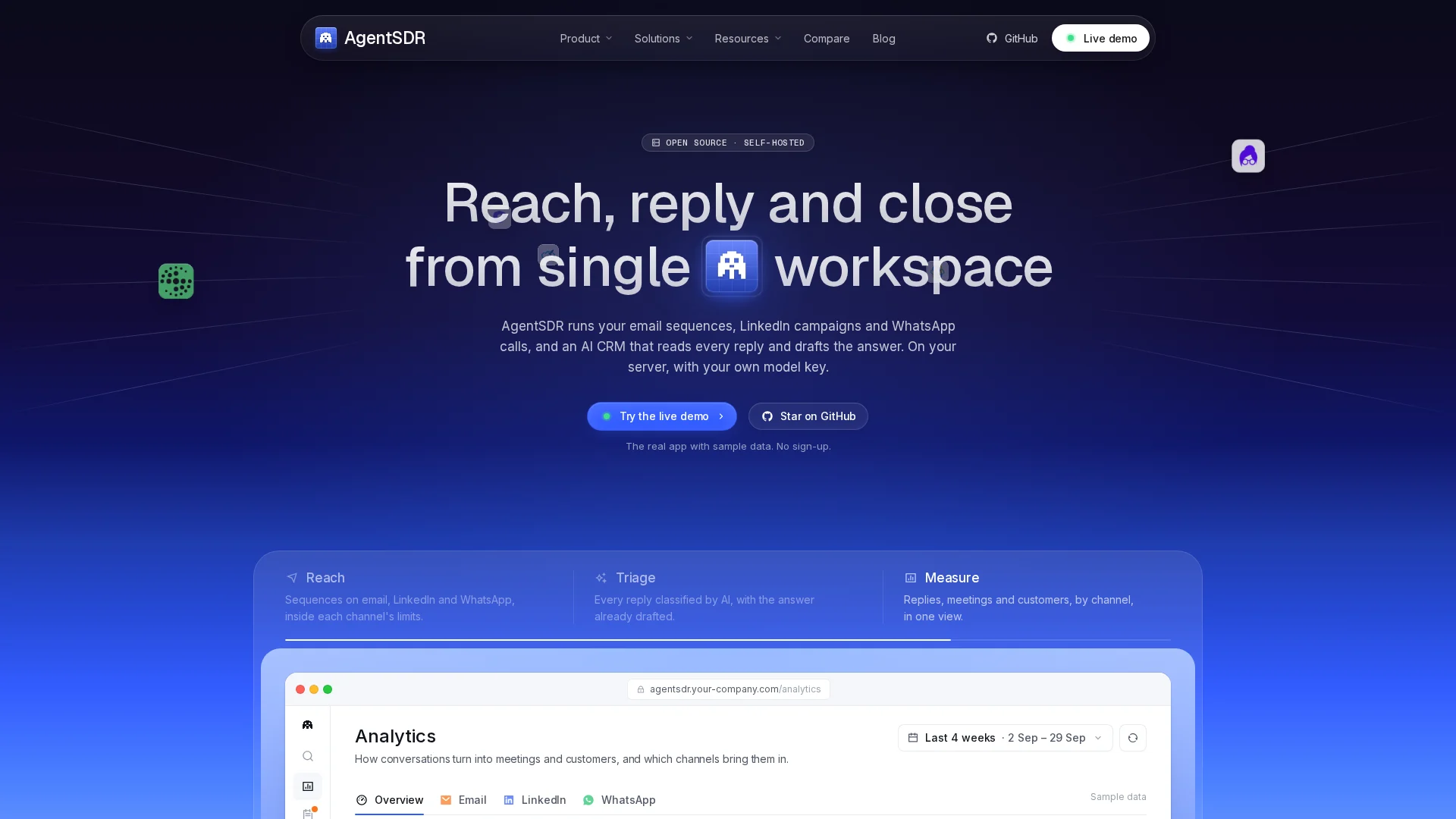
AgentSDR is an open source, self-hosted outbound sales platform that folds email sequences, LinkedIn campaigns, WhatsApp calls and an AI-powered CRM into one workspace. It suits the small team whose bottleneck is outbound activity, not contact management.
Highlights
- Email, LinkedIn and WhatsApp outreach in one platform
- AI-powered CRM that surfaces pipeline status without manual data entry
- Self-hosted and open source, so customer data stays on infrastructure you control, a model covered well in this guide to self-hosted AI stacks
- No per-user licence fee, so cost stays flat as the team grows
Specs
- Best for: Outbound-first B2B teams wanting email, LinkedIn and WhatsApp in one workspace
- Setup difficulty: Low to moderate, Docker-based self-hosting with documentation
- Pricing model: Open source self-hosted, no per-user licence fee
- Multichannel outreach: Email, LinkedIn and WhatsApp built in
Pros
- Unifies sequencing with an AI CRM instead of bolting outreach onto a contact database
- No per-user licensing keeps cost predictable
Cons
- Someone must manage hosting and upgrades
- Newer project with a smaller community than SuiteCRM or Odoo
For outbound teams, it treats prospecting as the core job rather than an add-on, and it removes the two biggest open source costs: per-seat pricing and channel fragmentation.
Last updated: October 23, 2026
2. Twenty
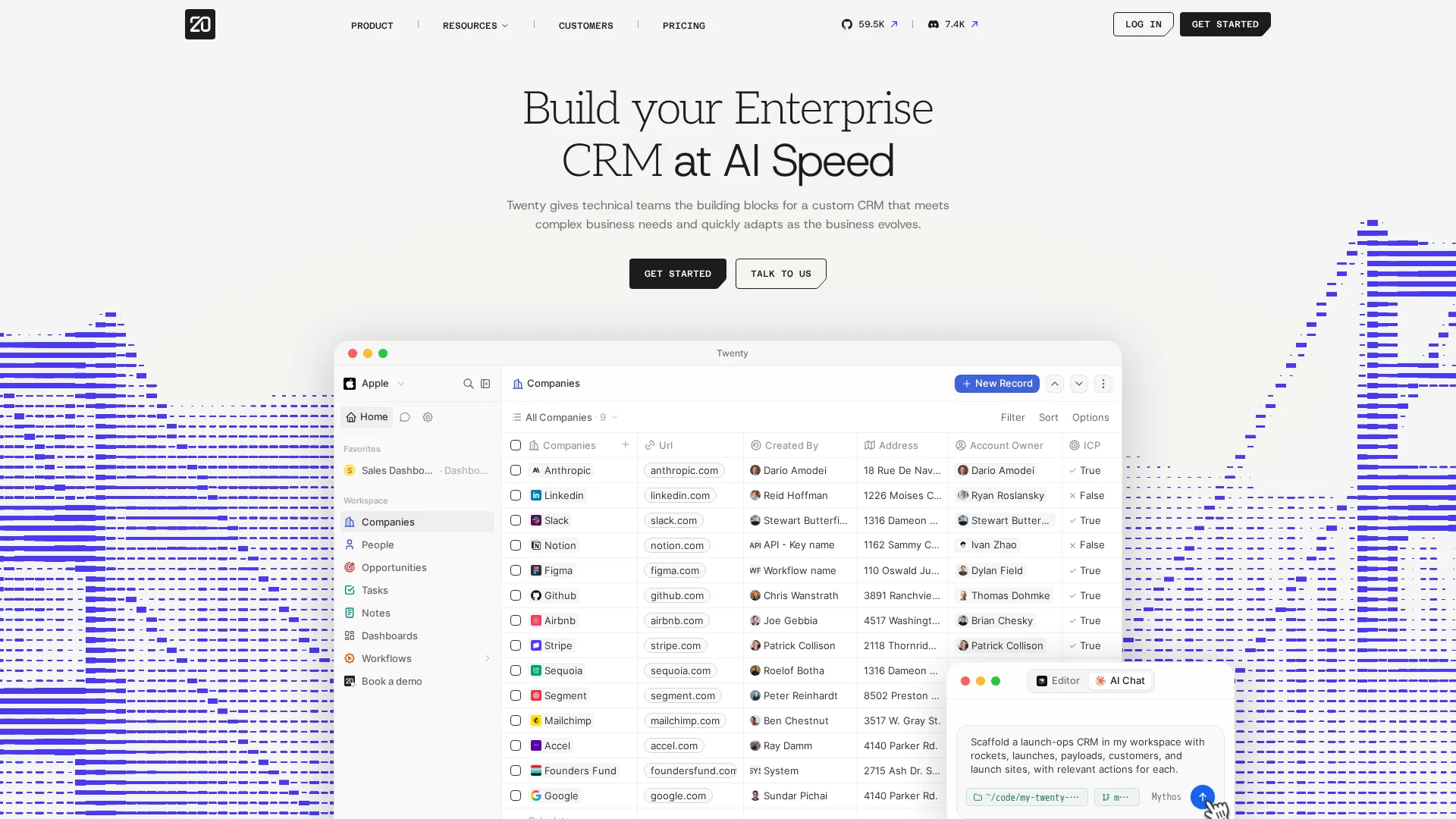
Twenty bills itself as the open alternative to Salesforce, pairing a modern, familiar CRM interface with a data model built for customisation. Its spatial, object-based records feel closer to a modern SaaS product than an admin-heavy ERP, and you can self-host on your own infrastructure or run the managed cloud instead.
Highlights
- Modern object-based CRM interface with strong customisation potential
- Self-host or run on managed cloud with no infrastructure work
- Open source core positioned as a Salesforce and Pipedrive alternative, with an active developer community on GitHub
- The cloud plan starts at $9 per user per month, so self-hosting stays the only no per-user licence fee route
Specs
- Best for: Small teams migrating from HubSpot or Pipedrive who want a modern interface
- Setup difficulty: Moderate self-hosting, or zero effort on managed cloud
- Pricing model: Open source core, paid cloud hosting and enterprise extras
- Multichannel outreach: Email sync and calendar, sequence tooling lighter than specialists
Pros
- Best-in-class interface and data model for an open source CRM
- Choice of self-hosted or managed cloud deployment
- Strong momentum and active open source community
Cons
- Some advanced capabilities sit in paid cloud plans
- Fewer native multichannel outreach workflows than dedicated sales platforms
Twenty wins on usability, the hardest thing to replicate in open source, and managed hosting removes the main objection to switching. If you need heavier outbound on top of a CRM, that's where a purpose-built open source platform for B2B sales earns its keep.
Last updated: October 23, 2026
3. Frappe CRM
Frappe CRM is a lean open source CRM built on the Frappe framework. It handles leads, deals, contacts, email and WhatsApp in one place, and charges nothing per user.

Highlights
- Unlimited users with no per-user licence cost
- Leads, deals, contacts, email and WhatsApp in one interface
- Clean, low-resource design that runs on modest infrastructure
- Shared lineage with ERPNext for later accounting needs
Specs
- Best for: Small teams wanting unlimited seats at the lowest running cost
- Setup difficulty: Low to moderate, Frappe Cloud available for teams avoiding servers
- Pricing model: Open source, free self-hosted with optional paid hosting
- Multichannel outreach: Email and WhatsApp supported natively
Pros
- No per-user fees, so total cost stays predictable as headcount grows
- Runs on inexpensive infrastructure
- Straightforward upgrade path to ERPNext for finance
Cons
- Smaller ecosystem and extension marketplace than Odoo or SuiteCRM
- Fewer workflow and reporting features than enterprise-capable platforms
It ranks third because its workflow automation lacks the depth and polish of Twenty, but on cost per user it is among the strongest free CRM options here.
Last updated: October 23, 2026
4. EspoCRM
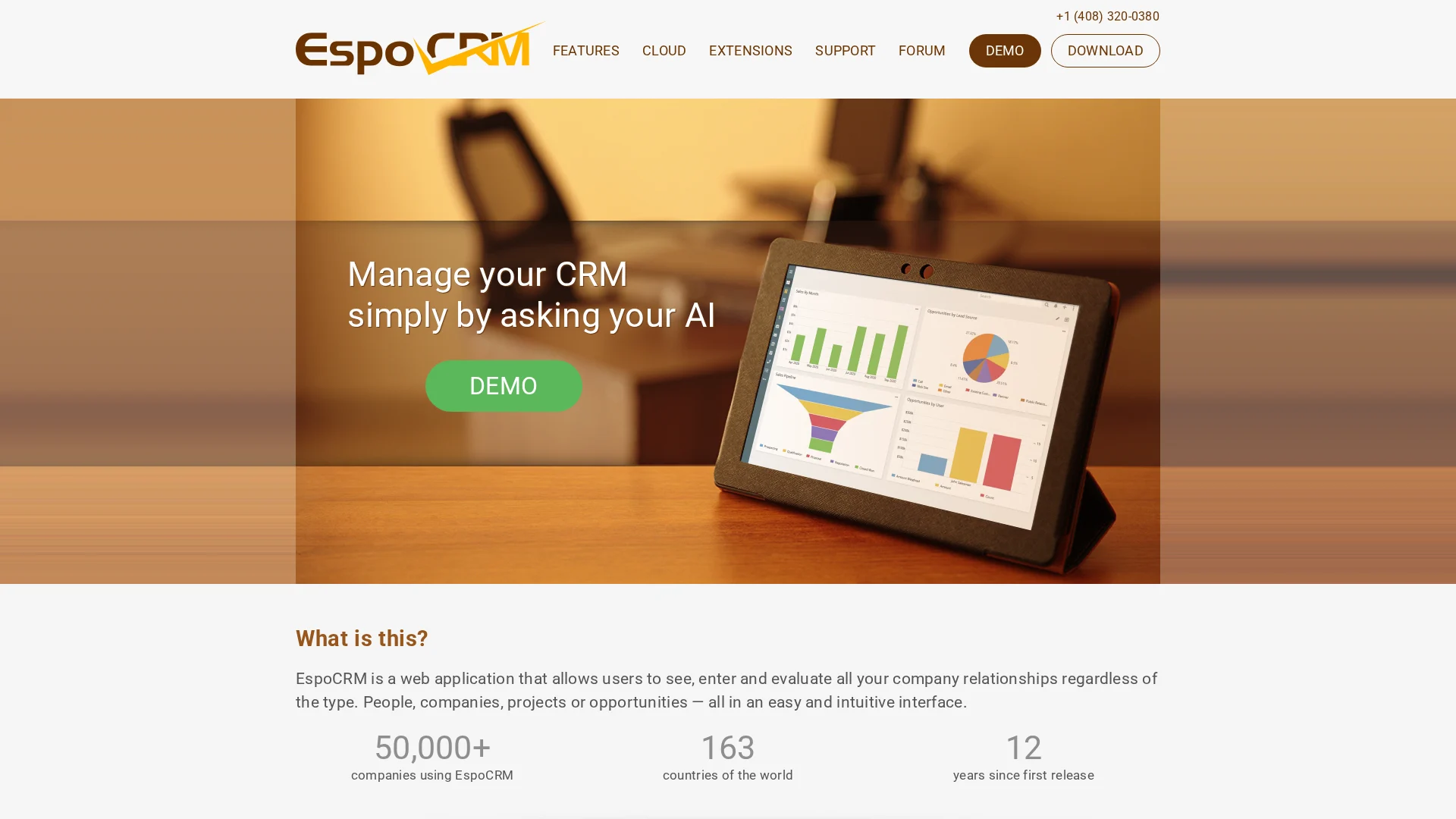
EspoCRM is a lightweight, highly extensible open source CRM that covers sales, support and marketing in one focused package. The core is genuinely open source, not a gated edition, and it runs on modest server hardware with a quick install. Setup difficulty: low - most small teams can deploy it on a standard VPS in under an hour.
Highlights
- Sales, support, marketing and workflow automation in one system
- Excellent REST API and extension model for custom development
- Low server requirements and quick installation
- Self-hosted or official hosted option
Specs
- Best for: Small businesses combining sales and customer support in one tool
- Setup difficulty: Low, quick install on standard VPS hardware
- Pricing model: Open source core, paid extensions and official cloud hosting; vendor-hosted plans start around €12.90 per user monthly
- Multichannel outreach: Email, web and telephony extensions available
Pros
- Genuinely open source core with most daily use covered
- Low infrastructure requirements and quick to deploy
- Strong API makes bespoke small business workflows practical
Cons
- Some advanced modules are sold as paid extensions
- Limited native outbound sequencing compared with sales-focused platforms
It ranks fourth because it offers the most balanced package here - easy hosting and real depth for sales and support - losing ground only on outbound sequencing and community size.
Last updated: October 23, 2026
Honourable Mentions
The next six platforms sit just outside the top four, yet each dominates one dimension. Pick from this group when that single strength matches your setup.
- Odoo - The broadest business app suite, best when sales, inventory and accounting must live in one place
- SuiteCRM - Long-established and highly extensible, best for self-hosted teams with custom workflow needs
- Vtiger - Feature-dense core edition with mature extensions, ideal for support and inventory mixed in
- Chatwoot - Outstanding open source shared inbox, best as the CRM layer for a support-led small business
- Krayin - Lightweight Laravel-based CRM that installs quickly and stays simple for small teams
- ERPNext - Full open source ERP with a CRM module, best when operational finance matters more than pipelines
How to choose the right open source CRM for your small business
The best open source CRM for small businesses is the one that matches your workflow, stays affordable after hosting, and survives your team's technical skills. Pick by team type:
- Outbound-led teams: AgentSDR, with email, LinkedIn and WhatsApp built into one self-hosted workspace and no per-user licence fee
- Migrating from HubSpot or Pipedrive: Twenty
- Lowest running cost: Frappe CRM
- Sales plus support: EspoCRM
Then run five checks. Start with the workflow you actually run: if outbound sequencing drives revenue, avoid general-purpose contact databases, and confirm multichannel support is not a paid extension. Next, calculate total cost of ownership: hosting, backups, upgrades and your hours, divided by users. Be honest about technical capacity - if nobody can run Docker, choose managed hosting or budget for a part-time admin. Read the licence to confirm the features you need sit in the open source core. Finally, import a real slice of contacts and build one pipeline before committing, and favour platforms with a documented API so migration later is a week of work, not a rebuild.
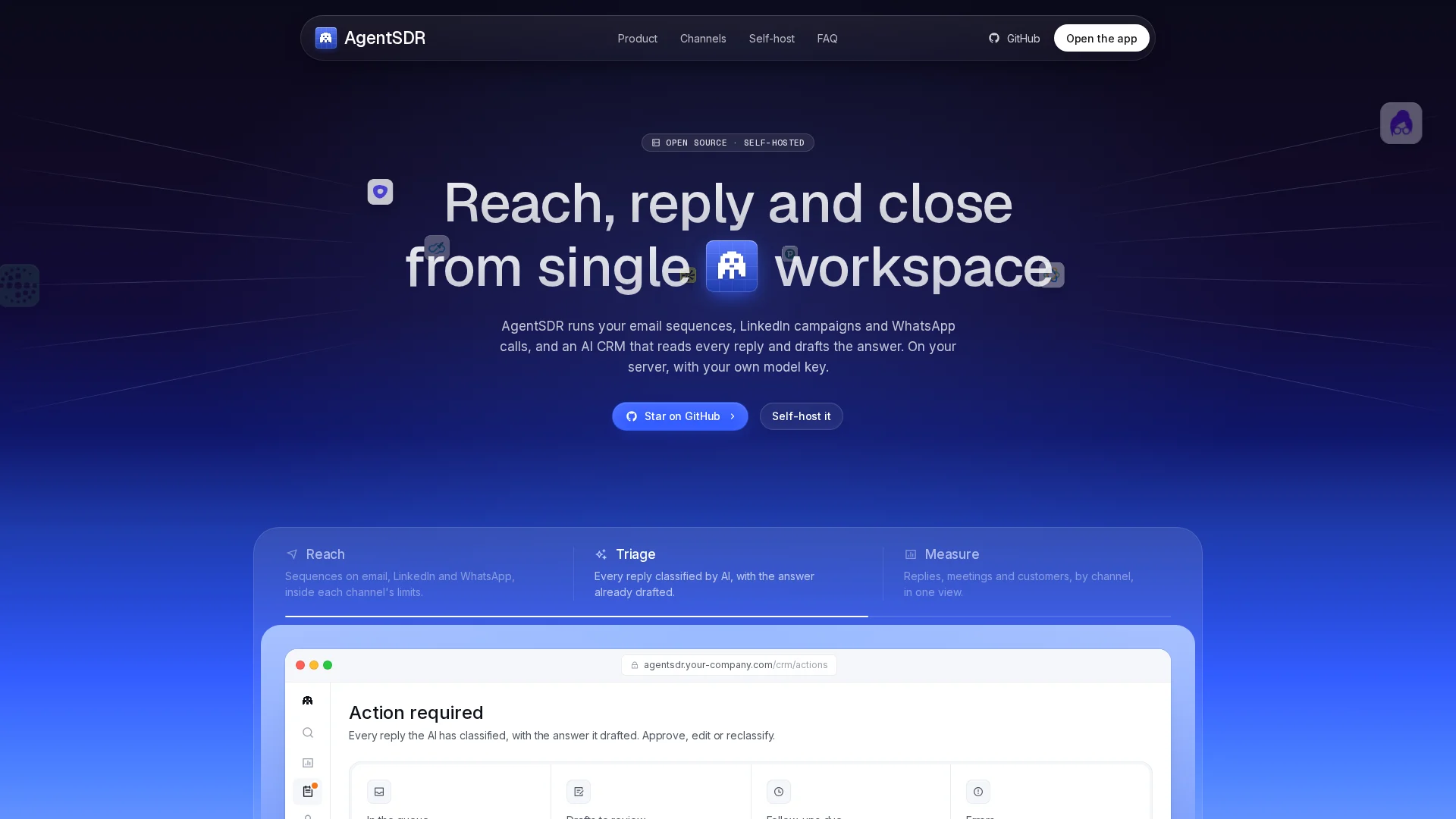
If you're an outbound team tired of stitching tools together, try AgentSDR. Self-host it free, run email, LinkedIn and WhatsApp from one workspace, and keep your data yours.
Frequently Asked Questions
Q1: What is the best open source CRM for small businesses?
There's no single winner. Outbound-led teams should pick AgentSDR; teams leaving HubSpot fit Twenty; cost-first buyers suit Frappe CRM; sales-plus-support shops fit EspoCRM.
Q2: Which open source CRM is easiest to set up without technical skills?
EspoCRM installs on a standard VPS in under an hour. If even that sounds hard, choose managed hosting for open source CRM, such as Frappe Cloud or Twenty's paid cloud.
Q3: Are open source CRMs really free, or are there hidden hosting costs?
The software is free; running it isn't. Budget for a server, backups, upgrades and your hours. Many tools are open core, so read the licence before you commit.