AgentSDR vs Salesforce: An AI CRM or Full Enterprise Suite?
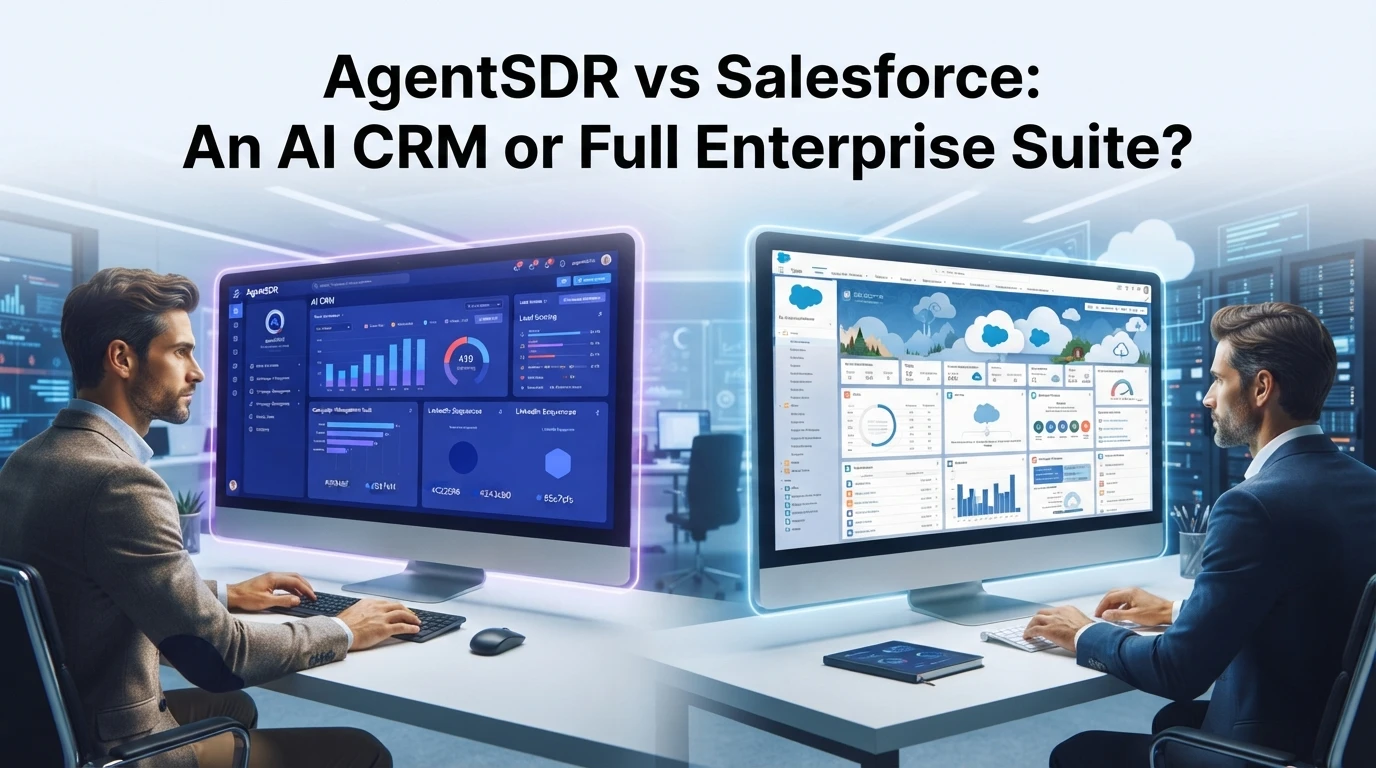
Quick Summary: Choose AgentSDR for outbound-focused teams that need email, LinkedIn, and WhatsApp prospecting with self-hosted data, quick setup, and no per-action AI fees. Choose Salesforce when you need broader enterprise coverage across sales, service, marketing, compliance, and governance, despite higher seats, usage costs, and implementation demands. The decision comes down to your workflow: booked meetings per rep or connected processes across departments.
Need email, LinkedIn and WhatsApp outreach live this quarter? AgentSDR wins on speed and cost. Running service and industry clouds with audited agent actions? Salesforce wins. The real issue is that the AI CRM vs enterprise CRM comparison hides two very different products. We break the choice into cost, capability, deployment and governance, then map each platform to your team size and motion.
AgentSDR vs Salesforce: At a Glance
| AgentSDR | Salesforce | |
|---|---|---|
| Pricing model | MIT-licensed code; you pay for your own server, model API key and channel services | Per user per month per cloud, plus Agentforce at $125 per user/month, $500 per 100k Flex Credits or $2 per conversation |
| Primary motion | Outbound prospecting: email sequences, LinkedIn campaigns, WhatsApp calls and messages | End-to-end relationship management across sales, service, field service and marketing |
| AI and automation | AI CRM classifies every reply, drafts grounded answers and follow-ups for approval, with your own model key | Agentforce agents with Prompt Builder, audit trails and governance, licensed on top of core seats |
| Deployment and data control | Self-hosted on your infrastructure; contact, reply and campaign data stays in your environment | Vendor-hosted SaaS with data residency options; customization runs through admins, Apex developers and partners |
| Implementation effort | Run it yourself in days; configuration over multi-month consulting and admin staffing | Typically multi-quarter rollout requiring certified admins, developers or a consulting partner |
| Best for | SDRs, founders, RevOps and agencies running outbound without enterprise license budgets | Large enterprises already invested in the Salesforce ecosystem with in-house or partner technical capacity |
How AgentSDR and Salesforce Compare
The AI CRM vs enterprise CRM question comes down to what each tool was built for. Here's who each contender serves and how it approaches the job.
AgentSDR
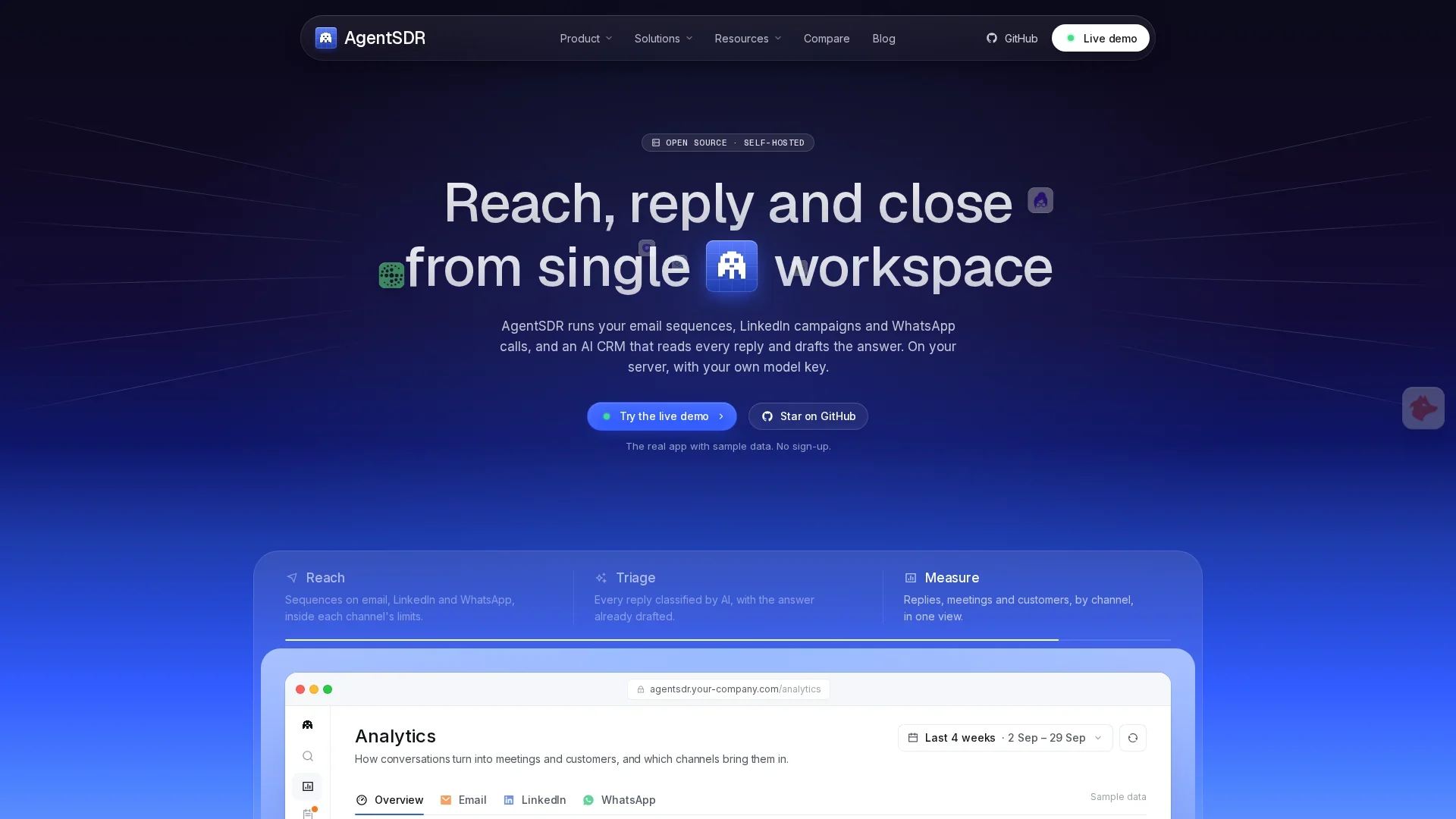
AgentSDR is an open-source, self-hosted outbound sales workspace. It combines email, LinkedIn and WhatsApp sequences with an AI CRM that classifies replies and drafts grounded answers for human approval. SDRs, founders, RevOps leaders and agencies running outbound without enterprise license budgets fit it best.
Key strengths
- Self-hosted, so contact, reply and campaign data stays in your environment
- MIT-licensed code; you pay for your own server, model key and channels
- Runs in days, without multi-month consulting or admin staffing
Salesforce
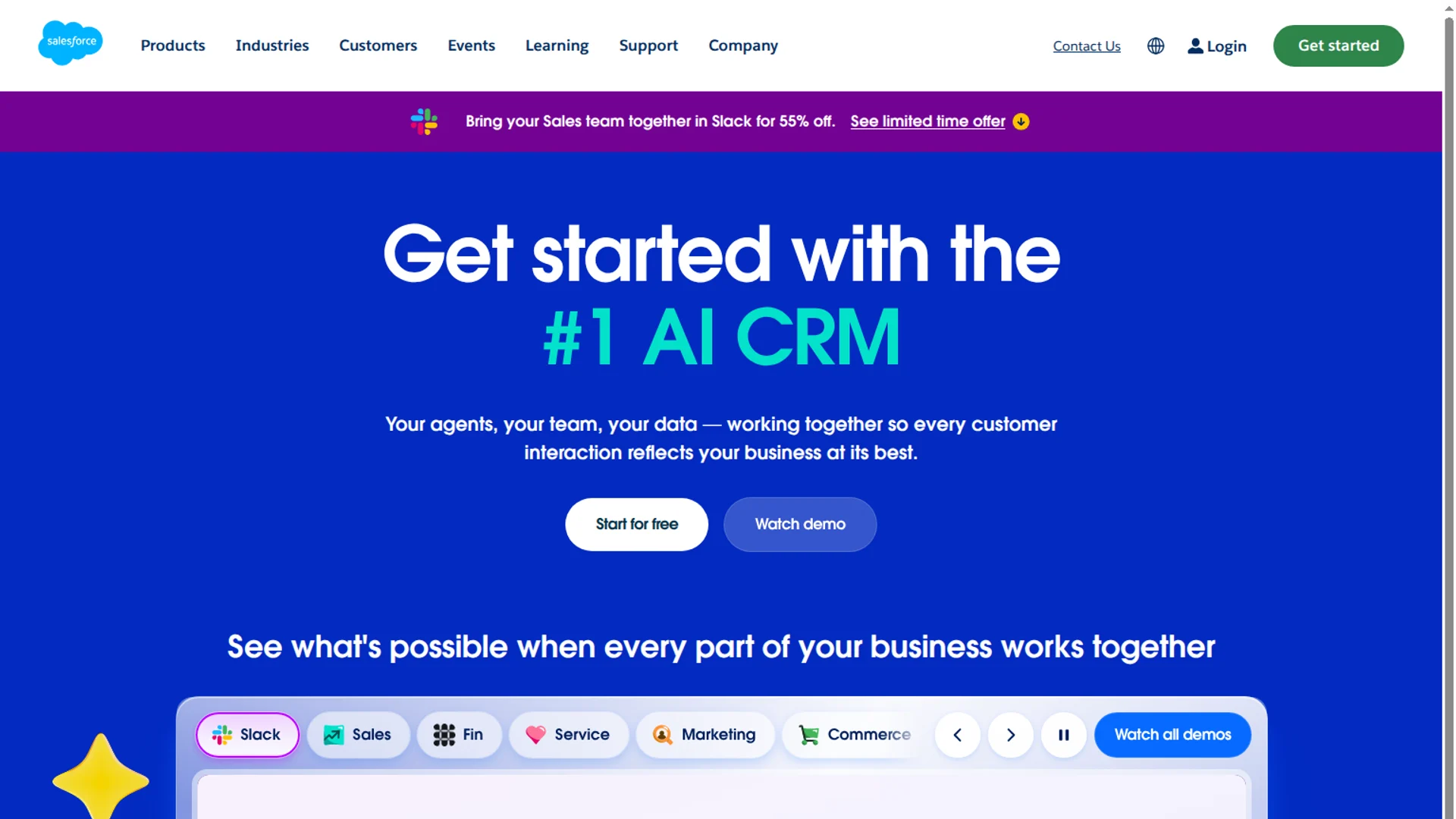
Salesforce is an enterprise CRM platform with separately licensed clouds. Its Agentforce AI agents are priced per user, per conversation or per action, on top of core seats. Large enterprises already invested in the ecosystem, with in-house or partner technical capacity, are its natural home.
Key strengths
- End-to-end coverage across sales, service, field service and marketing
- Agentforce agents with Prompt Builder, audit trails and governance
- Vendor-hosted SaaS with data residency options
Do You Need an AI-First CRM or a Full Enterprise Suite?
An AI-first CRM suits outbound-led teams that live in sequences, replies and pipeline. A full enterprise suite fits companies needing service, billing, reporting and compliance modules. Startups and SDR teams in cost-sensitive markets usually need speed and data control, not modules.

Match the platform to the motion you are actually running
If your motion is outbound: prospect, sequence, classify replies, book calls. An AI-first outbound platform like AgentSDR covers that loop and self-hosts your data. If you need quote-to-cash, case management and deep audit trails across departments, Salesforce earns its weight. Pick by workflow, not brand familiarity.
Infrastructure Cost Against Metered Agent Actions
Salesforce Agentforce costs $0.10 per action through Flex Credits or $2 per conversation, while a self-hosted AI CRM carries no per-action fee. Your bill becomes a fixed server cost plus a model API key instead of usage that grows with every campaign. At scale, metered pricing punishes exactly the behavior outbound teams need: more sequences, more replies classified, more drafts.
Why metered AI changes enterprise CRM math
Per-seat pricing was predictable. Metered AI is not, because each automated step charges you. Teams running high-volume outbound on Agentforce can spend more on actions than on seats, and costs are hard to forecast per rep. A self-hosted platform like AgentSDR inverts this: infrastructure is a known monthly number, and AI spend tracks your chosen model's rates. That keeps total cost of ownership flat as volume rises, which the per-action pricing shifts of 2025 made obvious.
Budgeting gets simpler too. When you can see your costs in advance, per-seat versus metered AI pricing becomes a governance question, not a finance surprise, and self-hosted outreach setups put that cap under your control.
Outreach and CRM Capability: Where Each Platform Actually Works

Channel coverage versus platform breadth
Salesforce gives you breadth. Service, marketing, analytics and a huge app marketplace all live under one roof, so it fits teams that want every function in one vendor. AgentSDR narrows the scope to outbound: email sequences, LinkedIn campaigns, WhatsApp calls and reply handling in one workspace, with data staying on your own server. Pick breadth when your bottleneck is cross-team process. Pick a focused AI outbound sales platform when your bottleneck is booked meetings per rep.
Which Should You Choose: AgentSDR or Salesforce?
Two checks before you sign either platform
For a small outbound sales team, the answer is usually simple: pick the self-hosted AI CRM and move on. Choose AgentSDR if you want:
- Low cost per rep with no per-action AI fees
- Data ownership on your own server
- Outbound focus: email, LinkedIn, WhatsApp in one place
Choose Salesforce if you need a full enterprise suite, deep integrations, or large compliance programs. Run the two checks: your total cost per rep for a year, and where your customer data must live. Your budget answers the first; your compliance policy answers the second.
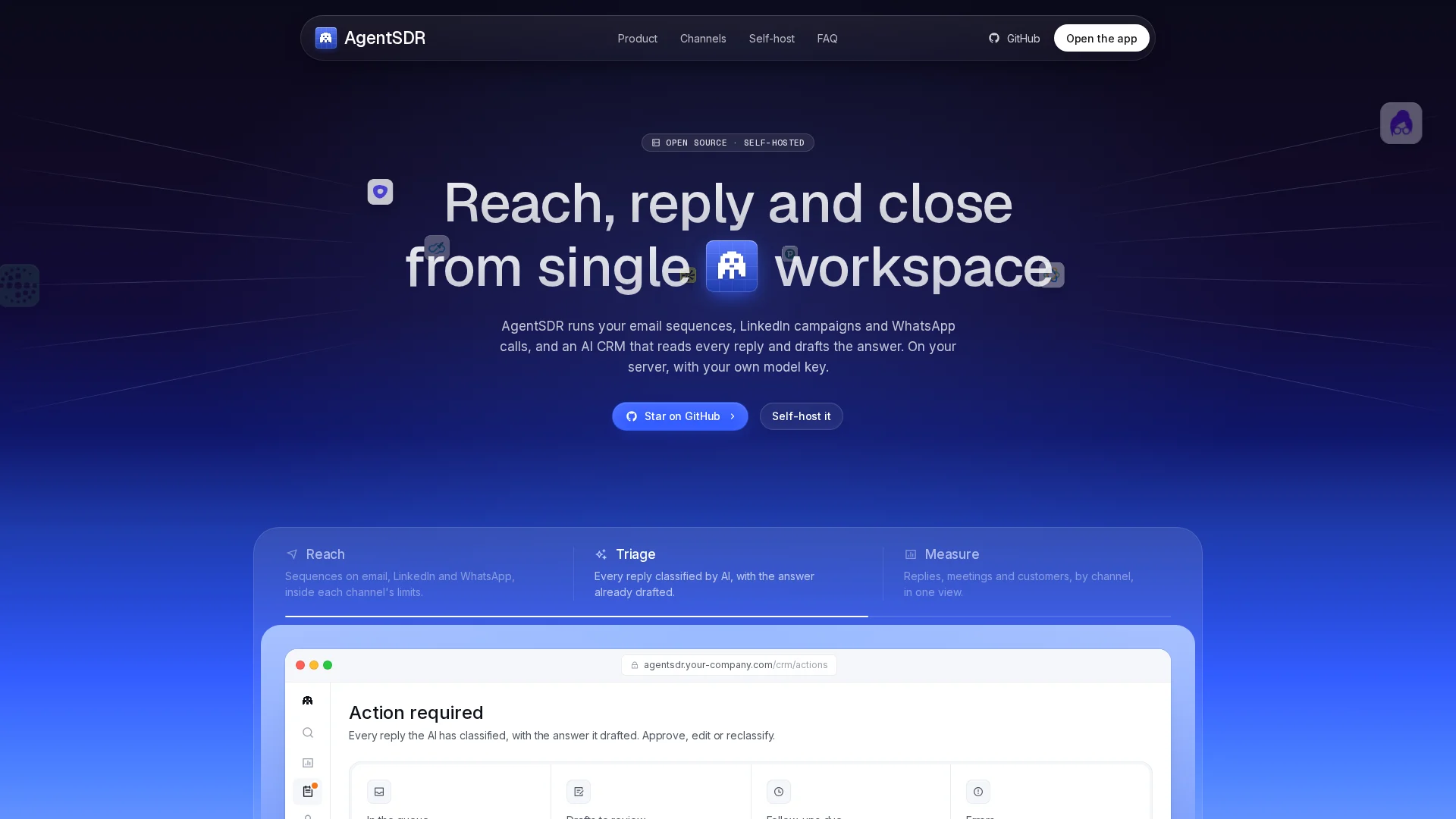
If per-action fees and per-rep seats are eating your margin, see what self-hosting removes. Try AgentSDR free and run your first outbound campaign this week.
Frequently Asked Questions
Q1: Do you need an AI-first CRM or a full enterprise CRM?
Pick by motion, not brand. Outbound-led teams needing sequences and reply handling fit an AI-first CRM like AgentSDR. Companies needing service, billing and compliance modules need a full enterprise suite.
Q2: Does Salesforce Agentforce pricing get expensive at scale?
Yes. At $2 per conversation or $0.10 per action through Flex Credits, metered AI can outgrow seat costs during high-volume outbound, making per-rep costs hard to forecast.
Q3: How fast can a self-hosted AI SDR go live?
Days, not quarters. You run AgentSDR on your own server with your model key, no certified admins or consulting partners required.
Q4: Who owns the data in an open-source AI CRM?
You do. Self-hosting keeps contact, reply and campaign data inside your environment, unlike vendor-hosted SaaS where residency options still route through the vendor.
Conclusion
The choice is motion, not brand. Pick AgentSDR for cheap, self-hosted outbound with flat costs and full data ownership. Pick Salesforce when service, compliance and enterprise breadth outweigh per-action fees.