Clay vs ZoomInfo SalesOS: Which Finds Better Accounts?
Quick Summary: Clay offers flexible enrichment across more than 150 providers at a lower entry price, making it a practical fit for RevOps-led teams sending roughly 1,000 to 5,000 leads monthly. ZoomInfo SalesOS suits larger teams that need an owned database, native intent signals, governance, and high-volume outreach, though its annual contract starts around $14,995. Test both with 100 to 200 closed-won accounts and compare accuracy, bounce rates, and per-record credit costs before choosing.
The Clay vs ZoomInfo question comes down to one test: is the account record in front of your rep right? Correct firmographics, a working email, a direct dial, and proof the account fits your ICP. This comparison breaks down data model, accuracy, real cost and best-fit team, then shows how to validate both against your own closed-won list before you sign.
Clay vs ZoomInfo SalesOS at a Glance
| Clay | ZoomInfo SalesOS | |
|---|---|---|
| Data model | No owned database; waterfall enrichment across 150+ providers | Proprietary owned database of 321M+ contacts and companies |
| Account data accuracy | Roughly 75-85% email accuracy depending on waterfall and credit budget | About 80-90% on verified records, single-source dependent |
| Cost structure | Monthly platform fee plus data credits; entry tier around $167/month | Quote-only annual contract from roughly $14,995/yr; credits per export, 3-seat minimum |
| Intent and outreach signals | No native dialer; intent via providers, outreach through sequencer integrations | Native intent topics and WebSights; Engage outreach sold as an add-on |
| Best for | SMB and mid-market teams (about 1k-5k leads/month) run by RevOps | Mid-market and enterprise orgs sending 5k+ leads/month |
How Clay and ZoomInfo SalesOS Compare
Clay
Clay is a GTM data orchestration platform. It stitches 150+ third-party data providers into spreadsheet-style enrichment and research workflows, so RevOps teams running about 1k-5k leads per month can build custom waterfalls instead of settling for one source.
Key strengths
- Waterfall enrichment across 150+ providers, with no owned database
- Roughly 75-85% email accuracy, depending on waterfall and credit budget
- Entry tier around $167/month plus data credits
ZoomInfo SalesOS
ZoomInfo SalesOS is an enterprise sales intelligence platform built on an owned database of 321M+ contacts and companies. It adds native intent data through intent topics and WebSights, with outreach sold as an Engage add-on, and suits mid-market and enterprise orgs sending 5k+ leads per month.
Key strengths
- Proprietary owned database of 321M+ contacts and companies
- About 80-90% accuracy on verified records, though single-source dependent
- Native intent topics and WebSights for buying signals
Which Platform Has Better Account Data Accuracy?
Neither platform wins on paper: Clay's waterfall enrichment across 150+ providers returns roughly 75-85% email accuracy, while ZoomInfo SalesOS hits about 80-90% on verified records but depends on a single source. Your own data decides.
- Clay: 75-85% email accuracy, depends on credit budget
- ZoomInfo SalesOS: 80-90% on verified records, single-source risk

How to Test Accuracy Against Your Own Closed-Won List
Validate with a closed-won account test before you buy either tool. First, export 100 to 200 accounts you already know well. Second, run them through each platform on a trial. Third, score fields like firm size, industry, and contact email against your records, and check the email bounce rate. Fourth, compare per-record cost, because accuracy at a higher credit spend may not be worth it. For a deeper look at account research methods, see our guide to sales prospecting software tools for account research.
Cost Structure and Time to First Campaign
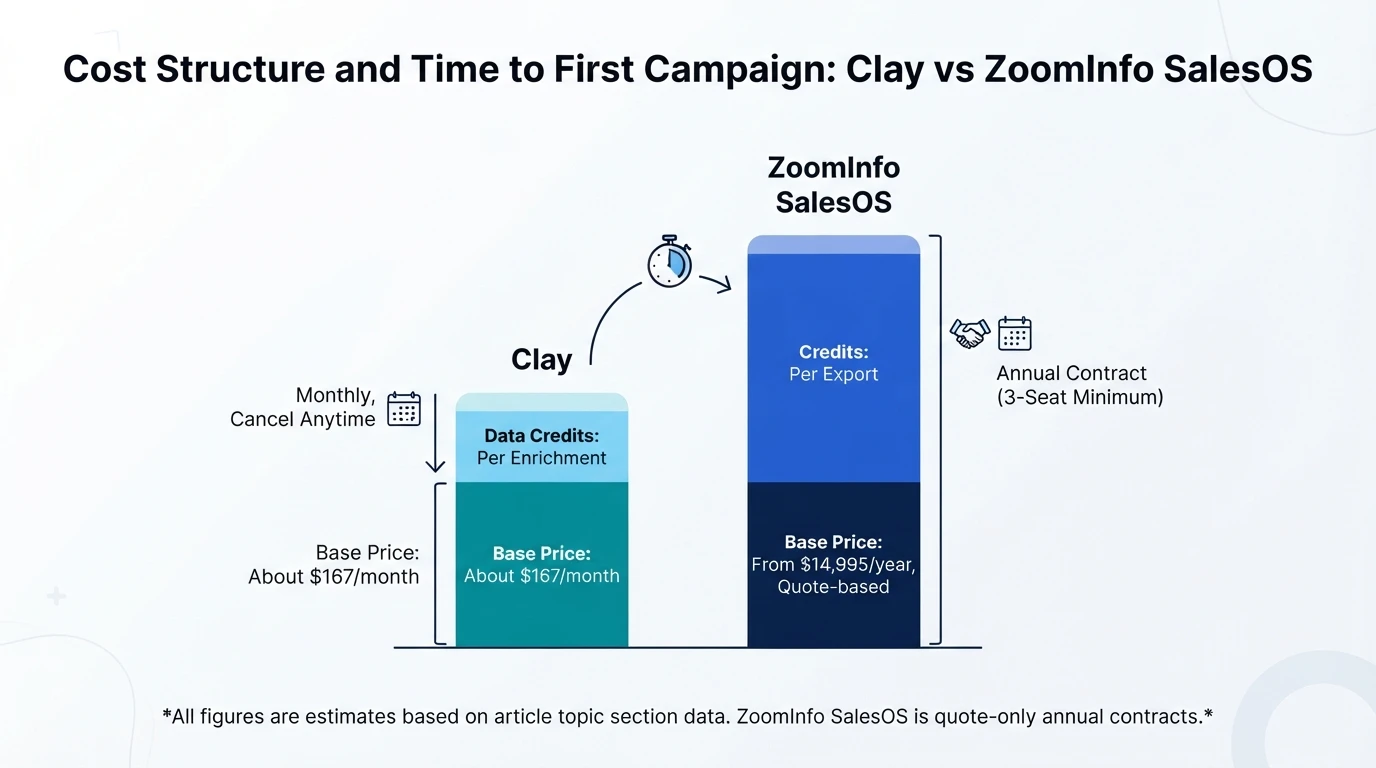
How much does ZoomInfo SalesOS cost compared with Clay? Clay starts around $167/month plus data credits; ZoomInfo SalesOS runs quote-only annual contracts from roughly $14,995/year with a three-seat minimum.
| Cost factor | Clay | ZoomInfo SalesOS |
|---|---|---|
| Base price | About $167/month | From $14,995/year, quote-based |
| Credits | Data credits per enrichment | Credits per export |
| Commitment | Monthly, cancel anytime | Annual contract |
Why Credits Change the Real Price of Both Tools
Sticker price hides the biggest variable. Clay burns credits through waterfall enrichment across 150+ providers, so heavy usage can triple your bill. ZoomInfo charges credits per export too. Estimate your monthly lead volume first, then price the credits before comparing plans, or use open-source alternatives to sidestep credit costs entirely.
Where ZoomInfo Still Wins: Scale, Intent Data and Enterprise Workflow
When Volume and Governance Outweigh Flexibility
Choose ZoomInfo over Clay when one or more of these apply:
- Your team sends 5,000+ leads per month and needs flat-rate volume, not credits
- You want native intent data and WebSights signals in one platform
- Legal or security rules require a vendor with SOC 2 controls and admin governance
- You need a single contract that covers data, engagement and CRM sync
Many teams run Clay or AgentSDR for enrichment while ZoomInfo covers enterprise reporting.
Which Should You Choose: Clay or ZoomInfo?
Pick Clay if your team is RevOps-led, sends about 1k-5k leads per month, and wants flexible waterfall enrichment at a low entry cost. You accept credit management as part of the job.
Pick ZoomInfo SalesOS if you send 5,000+ leads per month, want an owned database with intent data, and can absorb an annual contract from roughly $14,995.
For smaller teams, both may be overkill. Account research tools for lean outbound teams often cost less and cover the basics, and open-source platforms let you keep data control in-house. Whatever you pick, validate accuracy on your own accounts before signing.
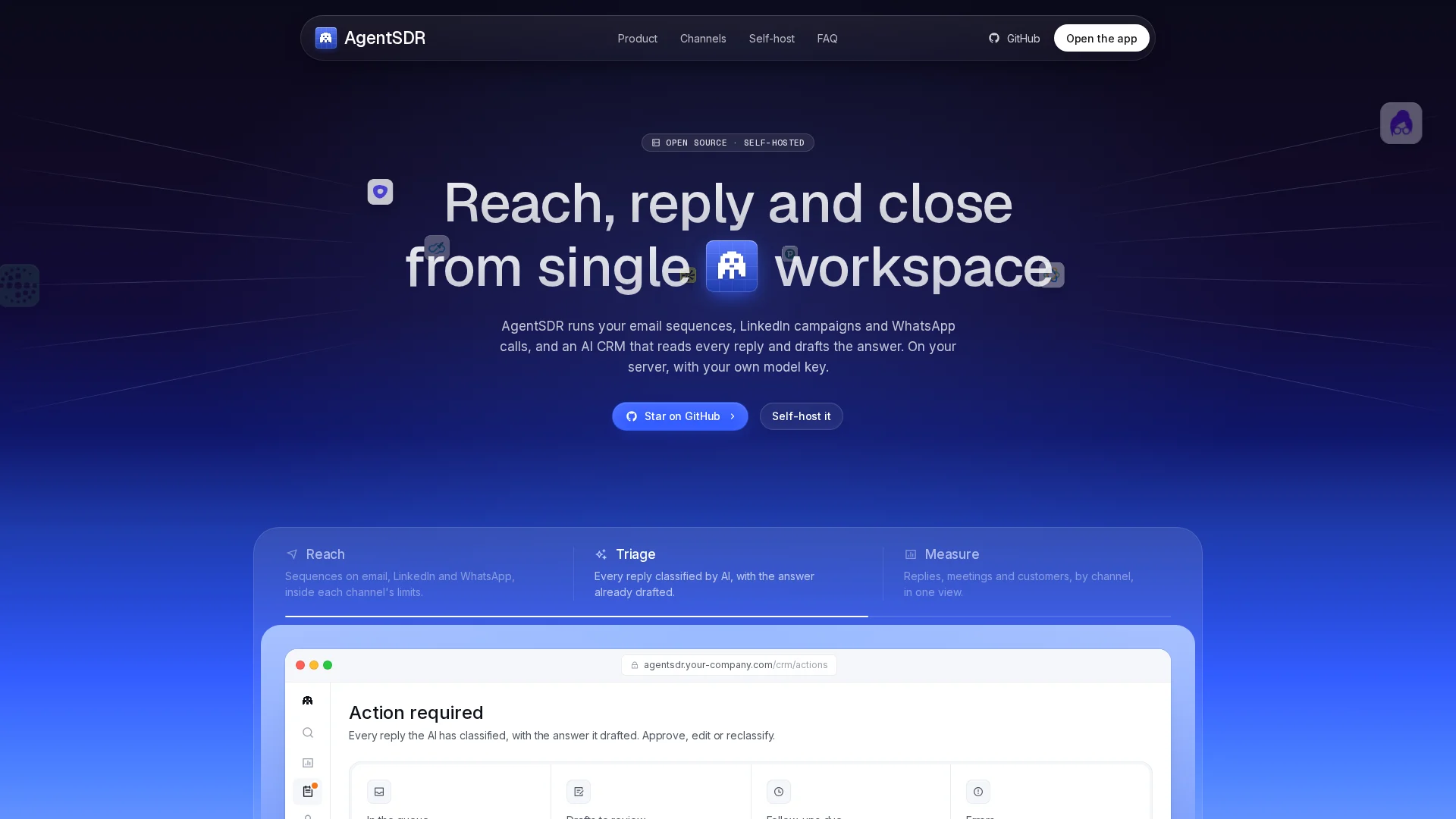
Test both on 100 real accounts before you buy. Need self-hosted outreach too? Try AgentSDR.
Frequently Asked Questions
Q1: Which prospecting platform has better account data accuracy?
Neither wins outright. Clay hits 75-85% email accuracy via waterfalls; ZoomInfo reaches 80-90% on verified records. Test both on your closed-won accounts.
Q2: Is ZoomInfo worth the annual contract?
Only if you send 5,000+ leads monthly and need native intent data. Otherwise credits and $14,995 minimums sting.
Q3: How do I compare enrichment costs fairly?
Estimate monthly volume, then price credits. Clay's waterfall usage can triple the sticker price.
Conclusion
Neither tool wins on paper. Clay offers flexible waterfall enrichment at lower cost; ZoomInfo brings scale and intent data. Pick by volume, budget, and team, then validate account data accuracy against your own closed-won accounts before signing.