AgentSDR vs Apollo: Which Outbound Platform Is Better?
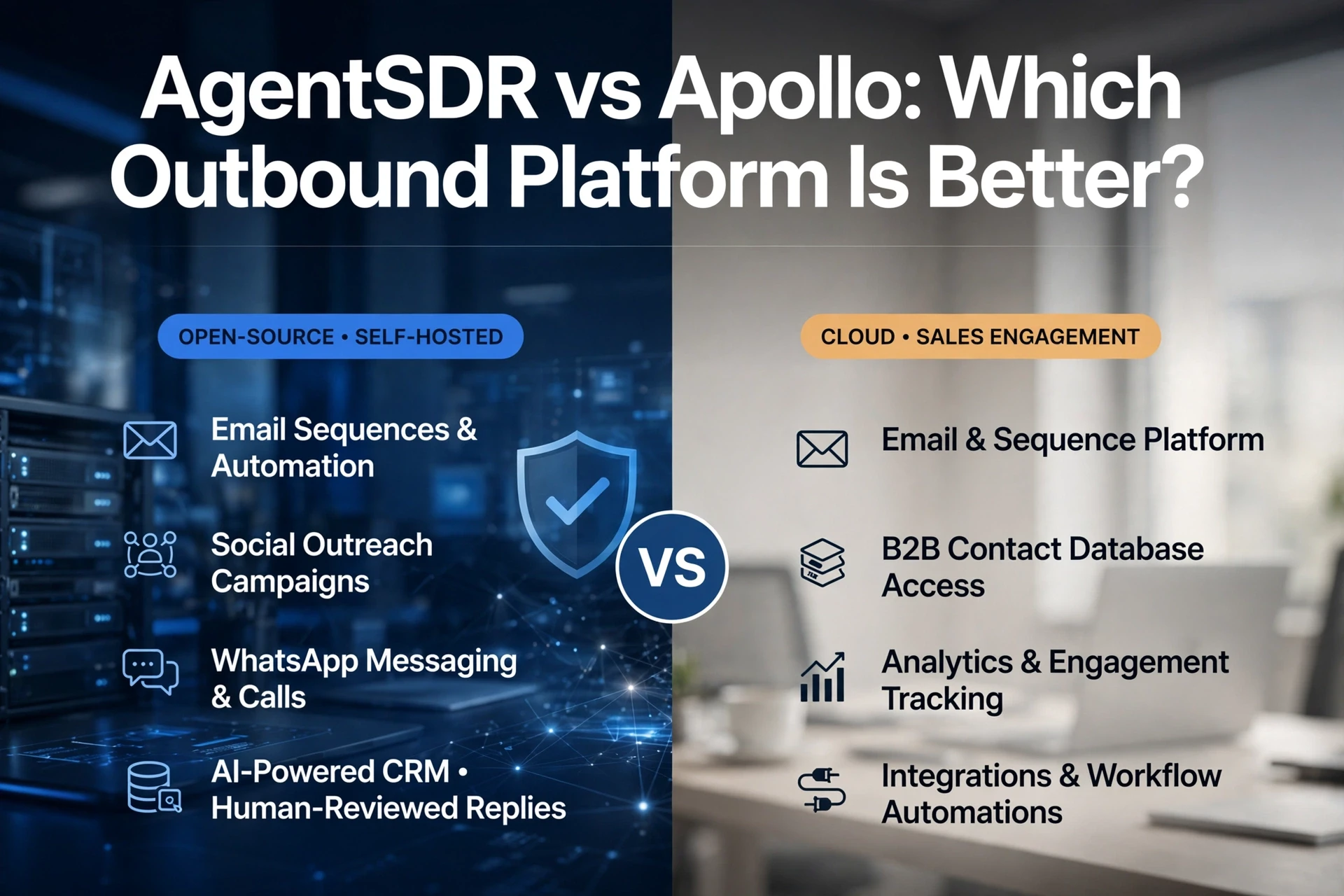
Quick Summary: Apollo is the better default for teams that want fast setup, a built-in database of 265M+ contacts, and hosted engagement tools without managing servers. AgentSDR fits teams that need email, LinkedIn, and WhatsApp in one self-hosted workspace, with their own data, AI model keys, and infrastructure, though they pay server, mailbox, and model costs without per-seat fees. Choose Apollo for convenience and bundled contact data; choose AgentSDR for multichannel control, data residency, and cost freedom.
Apollo is the safe default when you want a contact database and sequences on one contract. But if you run email, LinkedIn and WhatsApp from your own infrastructure, the AgentSDR outbound platform fits better. Most comparisons judge data coverage alone and miss the deployment and control differences that decide real cost. Here we compare prospect data, channels, reply handling and true price, then pick a winner for each buyer.
AgentSDR vs Apollo: At a Glance
| AgentSDR | Apollo | |
|---|---|---|
| Prospect data and sourcing | No native database; enrichment tables and CSV/XLSX merge fields, sourced externally | Native database of 265M+ contacts with search, filters and enrichment |
| Channel coverage | Email via Google Workspace mailboxes, LinkedIn via Unipile, WhatsApp calls and messages | Email sequences, native dialler with call recording, LinkedIn tasks and AI messaging |
| AI reply handling and CRM | Built-in AI CRM classifies replies and drafts grounded replies from your knowledge base | AI assistant for prospecting, writing and performance analysis plus CRM pipeline tools |
| Deployment and data control | Self-hosted on your server, MIT licensed, your own model key and database | Vendor-hosted SaaS, GDPR compliant, no self-hosted option |
| Pricing model | No per-seat SaaS fees; infrastructure and AI model usage cost you | Per seat per month: Basic $49, Professional $79, Organization $119 on annual billing, plus pooled credits |
| Best for | Teams wanting multichannel outbound with full data and infrastructure control | Teams wanting bundled contact data and engagement with zero infrastructure |
How AgentSDR and Apollo Compare
AgentSDR
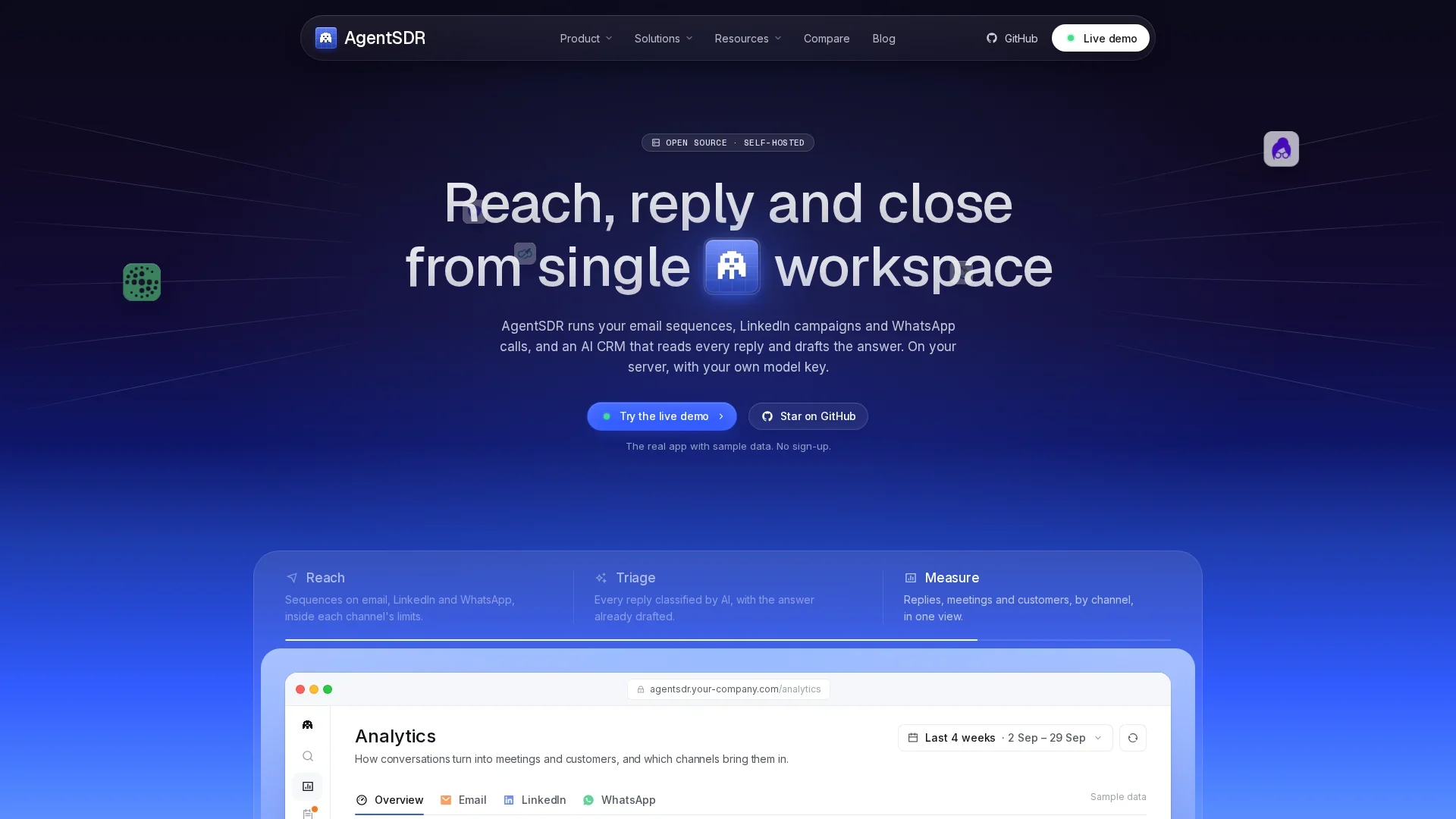
AgentSDR is an open-source, self-hosted outbound platform for teams that want full control of their outreach stack. It runs email sequences, LinkedIn campaigns and WhatsApp calls next to an AI CRM that classifies replies and drafts answers from your own knowledge base. Data stays on your server, so you set the infrastructure and AI costs.
Key strengths
- Self-hosted with your own model key and database
- Multichannel outbound: email, LinkedIn and WhatsApp
- Built-in AI reply classification and drafting
Apollo
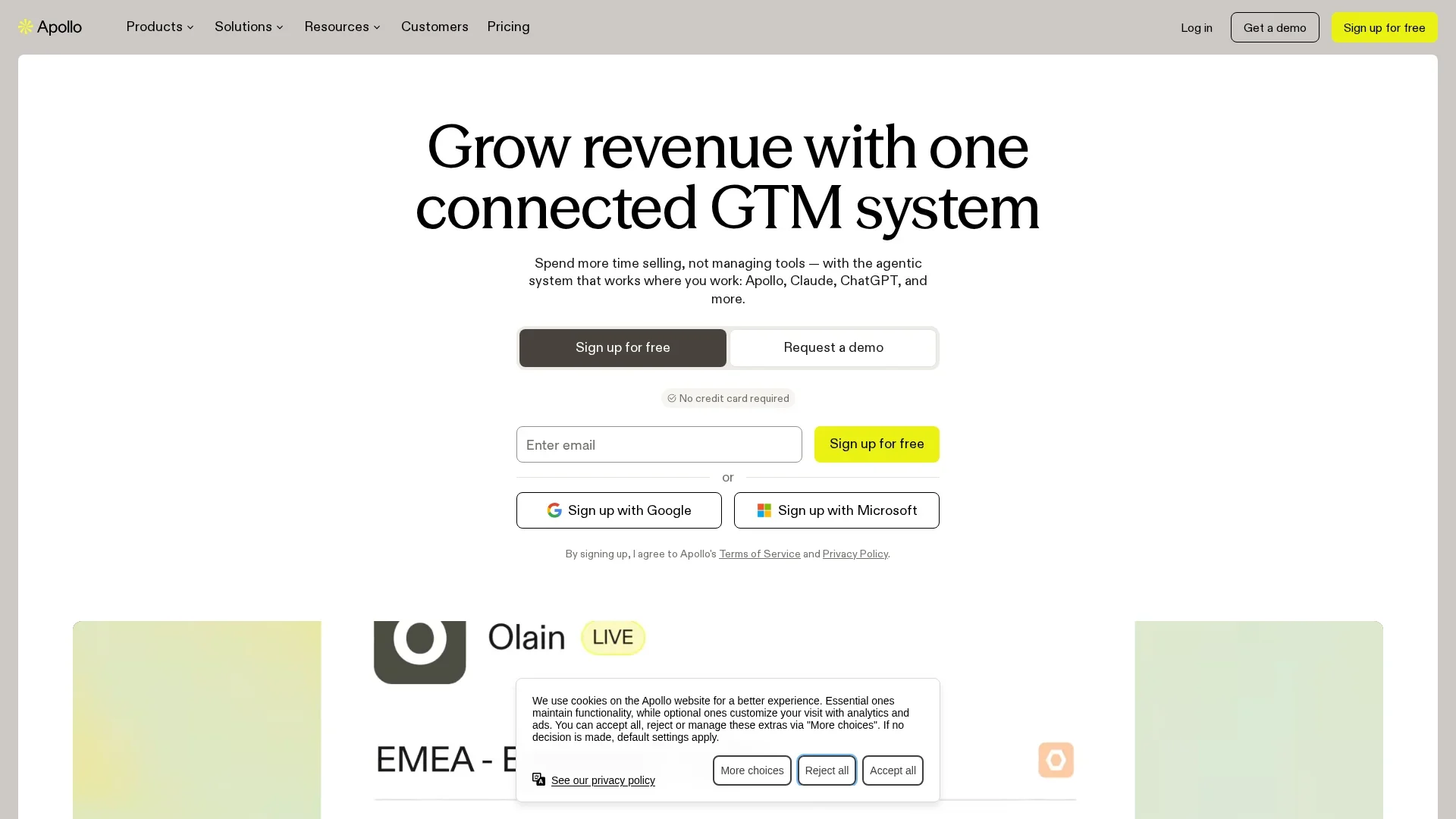
Apollo bundles a large B2B contact database with engagement tools in one vendor-hosted SaaS. Sales teams get sequences, a dialler with call recording, LinkedIn tasks and an AI assistant without running any infrastructure. You pay per seat, and contact credits are pooled across the plan.
Key strengths
- Native database of 265M+ contacts
- Email, dialler and LinkedIn tasks in one subscription
- Zero setup and no servers to maintain
Data Sourcing: Native Contact Database vs Bring Your Own
What Apollo's native database actually buys you
Apollo ships with a database of 265M+ verified contacts, so your team can search by role, region and company size and build lists without leaving the app. That speed matters for prospecting from scratch, though data quality still varies.

How enrichment tables work in AgentSDR
AgentSDR takes a bring-your-own-data approach. You import prospects through CSV upload, then map columns to enrichment tables that hold extra fields like company size or funding stage. The AgentSDR outbound platform keeps sourcing separate from sequencing, so you pick your own data vendor.
Channel Coverage and the AI Reply Layer
Email, LinkedIn and WhatsApp in one workspace
Apollo covers email sequences and LinkedIn automation natively, so most teams never leave the app to run a multichannel outbound platform play. WhatsApp is where the gap shows; you will need a third-party connector. Open-source tools like AgentSDR treat email, LinkedIn and WhatsApp as first-class channels in one unified inbox.

What happens when a reply arrives
Apollo sorts replies into interest categories and drafts suggested responses inside its inbox. AgentSDR goes further with AI reply classification: every incoming message is categorized, then a draft is prepared for a human to review before anything sends.
Unified inbox docs show how replies from all three channels land in one place.
Cost, Ownership and Control
Apollo seat and credit economics
How much does Apollo cost per seat in 2026? Free is $0. Basic costs $49, Professional $79 and Organization $119 per seat per month on annual billing. Each tier includes a yearly credit pool, so credits decide what you really pay once mobile and email credits run out.

The real cost of self-hosting
Self-hosting trades subscription fees for setup work. You pay for a server, mailboxes and AI model usage, and your team maintains the stack. There are no per-seat charges, and data stays in your own infrastructure, which matters for teams with strict data residency rules.
Which Should You Choose: AgentSDR or Apollo?
Neither platform is universally better for outbound; the right pick depends on how your team handles data sourcing, deployment, and channels:
- Pick Apollo if you want a hosted tool with a built-in contact database and no setup work
- Pick AgentSDR if you want open-source control, self-hosting, and true multichannel outreach
Choose Apollo if you need bundled data and zero infrastructure
Apollo works best when your priority is speed. Its hosted platform includes a native contact database, so reps can search, build lists, and launch sequences the same day. You trade flexibility for convenience and accept per-seat pricing.
Choose AgentSDR if you want control and true multichannel
AgentSDR fits teams that need email, LinkedIn, WhatsApp, and CRM in one self-hosted workspace. You keep customer data and AI usage under your own control, avoid per-seat fees, and can classify replies with AI while humans review responses. It suits teams comfortable running their own infrastructure.
Want outreach your team controls instead of renting? Try AgentSDR free and see self-hosted sequences plus AI reply triage in one workspace.
Frequently Asked Questions
Q1: How does AgentSDR compare with Apollo for outbound prospecting?
Apollo bundles a 265M+ contact database with hosted sequences and per-seat pricing. AgentSDR is a self-hosted outbound platform: you source data yourself, run email, LinkedIn and WhatsApp, and keep full control of costs and data.
Q2: Is AgentSDR really free since it is open source?
No. The software has no per-seat fees, but you pay for a server, mailboxes and AI model usage.
Q3: Does Apollo offer WhatsApp outreach?
Not natively. You need a third-party connector, while AgentSDR includes WhatsApp alongside email and LinkedIn.
Conclusion
Apollo wins on built-in contact data and fast setup. AgentSDR wins on control, true multichannel outreach and cost freedom. Pick Apollo for convenience; pick AgentSDR if data residency, self-hosting and no per-seat pricing matter more.