7 Sales Prospecting Software Tools for Account Research
Quick Summary: AgentSDR ranks first as a self-hosted, open-source workspace that connects account research directly to CRM context and outbound across email, LinkedIn, and WhatsApp. Clay leads for data coverage through waterfall enrichment across 200+ providers, while Apollo offers an easy-to-use all-in-one subscription and Attio provides the cleanest research-to-CRM workflow. The best choice depends on data freshness, CRM handoff, manual effort, hosting and cost control, accuracy on difficult lists, and fit with the sales motion.
Two SDRs can run the same sequence and see wildly different reply rates. The difference usually starts before the first email: one opened the account research, the other skipped it. Most teams buy outbound tooling for sending volume, then find the account list was stale and the contact data was guessed. We ranked these seven tools on account research instead: data sources, verification, and the speed of a usable brief. Each platform was scored on enrichment, CRM handoff, and the real cost of researching 100 to 500 accounts.
Account Research Tool Comparison
| Tool | Best for | How it sources account data | Setup effort |
|---|---|---|---|
| AgentSDR | Teams wanting research and outbound in one self-hosted workspace | Bring-your-own data plus AI-driven CRM enrichment and record context | moderate: self-hosting and initial configuration required |
| Clay | Teams prioritising contact coverage and verified data fields | Waterfall lookups across 200+ providers plus signal sources | Moderate to high: column design and provider ordering |
| Apollo | Teams wanting research, database and sequencing in one subscription | First-party database with built-in enrichment and firmographic filters | low: filters and list builder work immediately |
| Attio | Teams that want research stored natively in a flexible CRM | Automatic record enrichment plus AI attributes and agent research | Low to moderate: data model configured by the team |
What account research software actually does
Account research tools sit between lead sourcing and outreach. They identify a company, gather verified contacts and firmographic data, and hand that context to an SDR before a sequence starts.
The category spans single-vendor contact databases, multi-source enrichment platforms, and self-hosted sales engagement stacks. Data freshness and CRM handoff separate the good ones from the rest, because stale records cost reps hours of manual cleanup.
1. AgentSDR
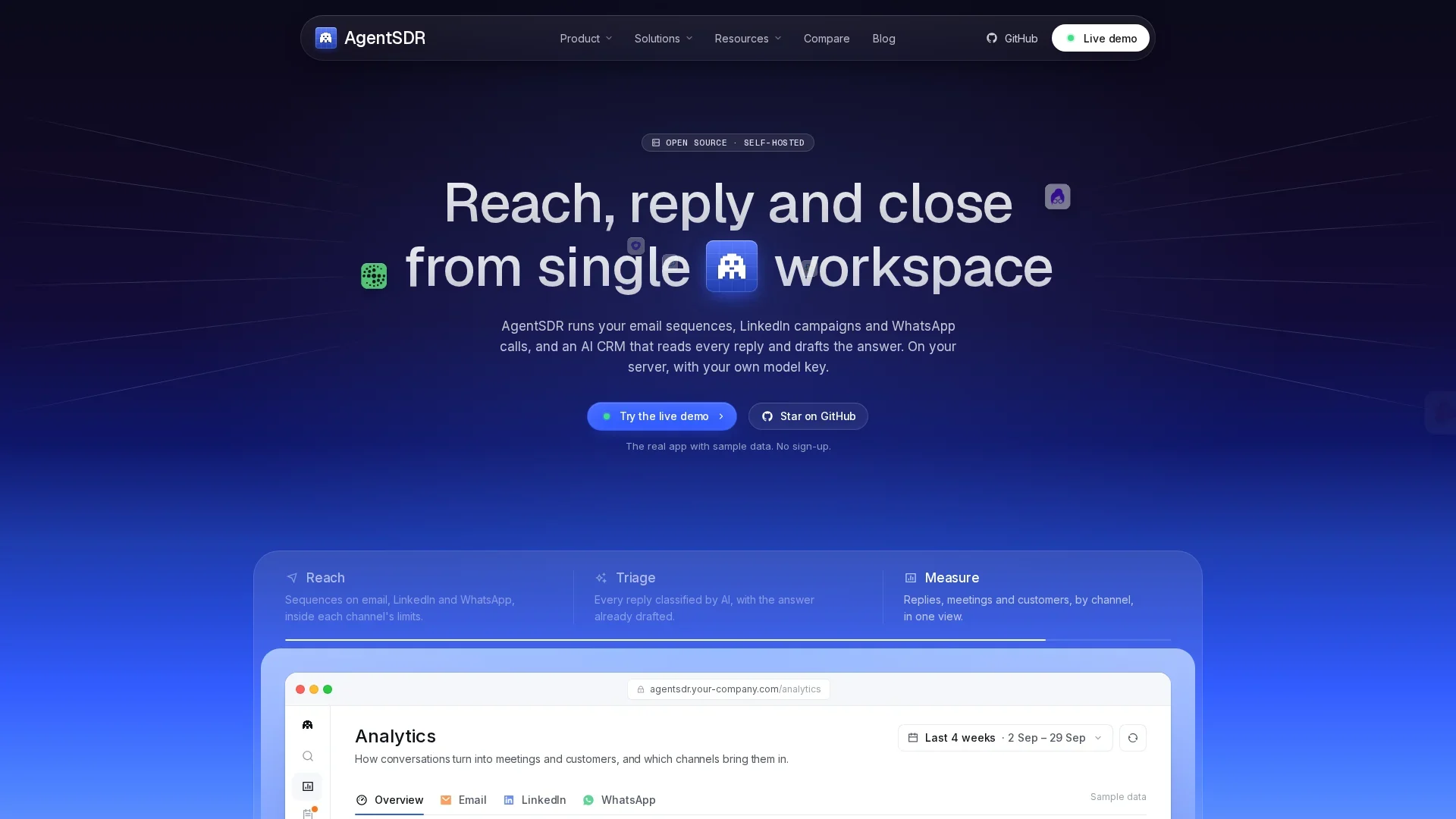
AgentSDR is an open-source, self-hosted outbound workspace where account research feeds straight into email, LinkedIn and WhatsApp sequences. Because data and the open source CRM live on your own infrastructure, you control data residency and cost. Self-hosting takes some setup, and data coverage depends on the providers you connect.
Highlights
- Research, sequencing, LinkedIn and WhatsApp in one place
- AI-powered CRM keeps account context tied to outreach history
- No per-seat pricing or vendor lock-in
Specs
- Best for: Teams wanting research and outbound in one self-hosted workspace
- How it sources account data: Bring-your-own data plus AI-driven CRM enrichment and record context
- Setup effort: moderate: self-hosting and initial configuration required
Pros
- Data residency and cost control for growing teams
- Full chain from research to sending without a paid CRM in between
Cons
- Self-hosting requires technical setup and maintenance
- Smaller ecosystem than the largest commercial platforms
It ranks first because it removes the gap between research and execution.
Last updated: November 16, 2026
2. Clay
Clay is a spreadsheet-style research platform whose waterfall enrichment cross-checks 200+ data providers to fill in account and contact fields. It keeps a result only when the confidence threshold is met, so match rates on hard-to-find roles stay high. As B2B data enrichment goes, this is the deepest coverage here.
Highlights
- Waterfall enrichment across 200+ data providers for field coverage
- Spreadsheet interface with flexible columns for account research
- Extensive integration library for CRM handoff
- Enrichment, signals and prospecting workflows in one place
Specs
- Best for: Teams prioritising contact coverage and verified data fields
- How it sources account data: Waterfall lookups across 200+ providers plus signal sources
- Setup effort: Moderate to high: column design and provider ordering
Pros
- Best-in-class field coverage and match rates
- Flexible visual tables for bespoke research
- Deep integration ecosystem
- Scales from single rep to RevOps workflows
Cons
- Credit-based data costs rise quickly with list size
- Not a CRM or sequencer, so a second tool is required
- Steep learning curve for non-technical users
It ranks second because its research accuracy is the deepest in the category, but it still needs a separate sequencing tool and gets expensive at volume.
Last updated: November 16, 2026
3. Apollo
Apollo bundles a large contact and company database with firmographic filters, list building and sequencing in one subscription. For account research, its strength is breadth: narrow accounts by headcount, industry, technology or funding, then work the people inside each one and send without switching tools.
Highlights
- Large contact and company database with strong firmographic filters
- Technology and headcount filters for account selection
- Built-in email and LinkedIn sequencing
- Native data enrichment and usage views
Specs
- Best for: Teams wanting research, database and sequencing in one subscription
- How it sources account data: First-party database with built-in enrichment and firmographic filters
- Setup effort: low: filters and list builder work immediately
Pros
- Single platform from research to sending
- Intuitive filters for target account selection
- Free tier for list building and basic use
- Large amount of user and integration ecosystem
Cons
- Database accuracy varies by role and region
- Export and sequencing caps on lower tiers
- Less flexible than a spreadsheet-style research workflow
Paid plans run from $49 to $119 per user per month on annual billing, according to Cognism's pricing breakdown, and caps on exports push heavier users toward higher tiers, as UpLead's review notes. Apollo ranks third because research and execution sit in one product with a low barrier to entry. It trails Clay on contact coverage per field and trails AgentSDR on data control and cost predictability, but it remains the most complete single subscription for a team starting out.
Last updated: November 16, 2026
4. Attio
Attio is the most CRM-native entry here. Records enrich automatically with logos, profile details, social handles and descriptions, and AI attributes let teams categorise and summarise accounts against their own framework, as Attio shows in its [AI attributes walkthrough](
). A web agent can research accounts on autopilot, and this style of AI CRM keeps everything learned during research ready for pipeline reporting.
Highlights
- Automatic enrichment of person and company records
- AI attributes that categorise and summarise accounts
- Flexible, configurable data model for research fields
- Agent-led account research and email and calendar sync
Specs
- Best for: Teams that want research stored natively in a flexible CRM
- How it sources account data: Automatic record enrichment plus AI attributes and agent research
- Setup effort: Low to moderate: data model configured by the team
Pros
- Records stay enriched without manual updates
- Highly customisable data model
- Strong native email and calendar sync
- Modern, fast interface
Cons
- Contact and company database is smaller than Apollo's
- Research is tied to CRM structure
- Limited built-in sending compared with dedicated sequencers
It ranks fourth because it delivers the cleanest research-to-CRM handoff, though research stays tied to CRM records, so teams wanting a standalone prospecting pipeline, or a self-hosted workspace like AgentSDR, look elsewhere.
Last updated: November 16, 2026
Honourable Mentions
Three more tools earned a spot by handling part of the research-to-outreach chain well, even though each stops short of being a full account research system like the four above.
- Lemlist - Solid lead database search and multichannel sequencing, though research depth is limited by a single enrichment pass.
- Smartlead - Great for building and sending large researched lists, but research is a preprocessing step rather than the core feature.
- HeyReach - Best for researching individual decision-makers on LinkedIn, with little company-level context.
How to choose the right account research tool
Pick sales prospecting software for account research by testing six things: where the data comes from, how results reach your CRM, how much manual checking is left, hosting and cost control, accuracy on your hardest list, and fit with your sales motion.
- Data source. A single vendor database is fast and predictable. Waterfall enrichment across many providers maximises coverage on niche roles.
- CRM handoff. Prefer tools that write enriched context straight into your CRM. The gap between a researched list and a live sequence is where deals stall.
- Manual effort. If enrichment still needs a human to verify every field, it will not scale past a small team.
- Hosting and cost. For data residency, compliance or budget control, weigh self-hosted options like AgentSDR against per-seat pricing that grows with every new rep.
- A real test. Run your hardest list first. A small sample of hard-to-find roles reveals accuracy problems that demo data hides.
- Sales motion fit. Broad list prospecting, ABM account selection and one-to-one executive outreach each reward different features.
Judge prospecting data freshness on your own worst data, not the vendor's sample file.
If you want research, sequencing and an AI CRM in one self-hosted workspace, AgentSDR is the standout pick. Teams that need maximum field coverage should look at Clay instead.
Tired of stale account data slowing your outbound? AgentSDR puts prospecting, sequences and CRM in one self-hosted workspace you control. Explore it free.
Frequently Asked Questions
Q1: Which prospecting tools give SDRs accurate account data?
Clay verifies fields through waterfall enrichment across 200+ providers, Apollo uses a first-party database with firmographic filters, Attio enriches records automatically, and AgentSDR relies on bring-your-own data plus CRM enrichment.
Q2: How do I test contact data accuracy before buying?
Run your hardest list first; niche roles expose stale records that demo data hides.
Q3: Which tool suits teams needing data residency control?
Self-hosted options keep customer data and AI usage on your own infrastructure.